
We’ve all gotten pretty good at personalization.
We use first names in subject lines. We’re experts at crafting messages “just for you.” And yet, many benefit communications still go unopened, unread, or forgotten the moment they land in the mailbox, virtual or otherwise.
The problem isn’t effort. It’s timing.
When it comes to benefit communications, when a message shows up matters far more than how cleverly it’s customized. A beautifully written email that arrives at the wrong moment is still noise. A simple, timely nudge that aligns with real life? Now, that feels like care.
Personalization isn’t about sounding personal. It’s about being present at the right moment.
Let’s say it how it is: not all personalization is meaningful.
Seeing your name in an email doesn’t make the message relevant. Neither does a subject line that promises something personal but delivers a generic reminder that could apply to anyone, anytime.
We’ve confused “I know who you are” with “I understand what’s happening in your life right now.”
Employees don’t feel supported because their name appears in an email. They feel supported when the information they need shows up at the moment it matters, with clear next steps that make life easier and benefits actually beneficial. That’s where timing takes the lead.
Benefits don’t exist in a vacuum. They intersect with life—milestones, transitions, and moments that already carry emotion, urgency, or change. That’s where communication has the greatest impact.
Think about the moments when benefits suddenly become relevant:
Connecting with employees during these moments of transition serves as meaningful reminders that benefits touch everyday life, not just Open Enrollment. None of these moments require fancy language. They require awareness, empathy, and timing.
It’s tempting to believe the answer is better segmentation. Smaller lists. More filters. More rules.
But even the most precisely targeted message falls flat if it arrives too early, too late, or disconnected from real life. Event-based communication shifts the strategy from guessing to responding.
Instead of asking, “Who should get this?” the better question becomes, “When will this actually be useful?”
That shift alone can transform benefit communications from something employees tolerate into something they trust.
Of course, no HR team is manually tracking every life event or milestone—nor should they have to.
That’s where automation plays a critical role. Tools like Email+ allow organizations to trigger timely, relevant messages based on real moments, without adding administrative burden. And while digital communication works well for many touchpoints, physical mail still has a place. A thoughtfully timed postcard can cut through the noise, especially during emotionally significant moments when an email may feel too transactional.
Personalization isn’t about making messages sound personal. It’s about making them feel personal by showing up at the right time. If you want benefits communication to stop being ignored, it’s worth stepping back and asking:
Are we sending this because it’s on our calendar… or because it’s relevant to theirs?
Does this message help someone act, decide, or feel supported right now?
When benefits information shows up in moments that matter, employees don’t just read it, they use it. And that’s when communication starts doing its real job.
Want help getting started? Our team at CPI is ready to connect with you! Fill out this form or email hello@commpart.com.
Contact our award-winning experts.
View our product videos.
Download the possibilities.
By submitting your email address, you agree to receive periodic communications from Communication Partners, Inc. We will never share your information with third parties or social marketing firms.
We use cookies to improve your experience on our site. By using our site, you consent to cookies.
Manage your cookie preferences below:
Essential cookies enable basic functions and are necessary for the proper function of the website.
You can find more information in our Privacy Policy and .
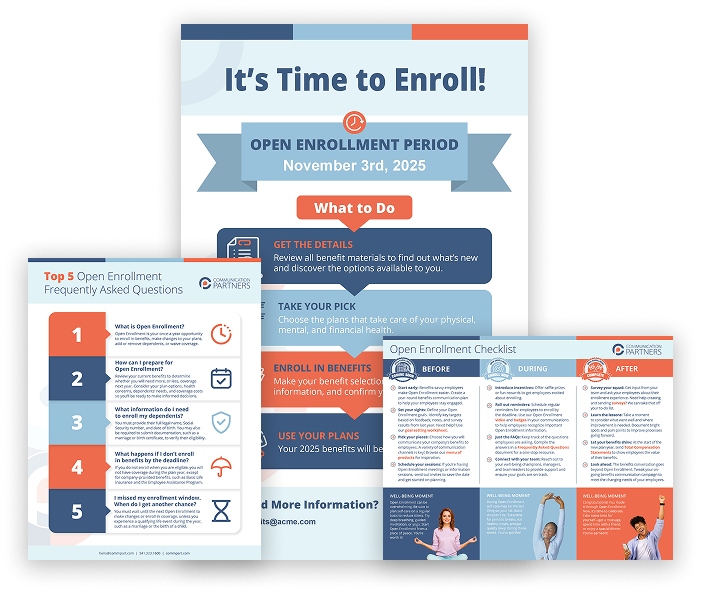
Click the button below to view and download your FREE Enrollment Toolkit.
Providing the highest level of hospitality is important to us. Surveys give us the feedback we need to continually meet this goal. We’re pretty proud of our Net Promoter Score (NPS). Here’s why:
NPS is based on the percentage of survey respondents who are promoters, passives, and detractors:
Scores range from -100 to 100. The higher the score, the higher the percentage of promoters versus detractors.
| Above 0: Good |
| Above 20: Favorable |
| Above 50: Excellent |
| Above 80: World Class |
*Bain & Company, creators of NPS