
6 Problems We’re Solving in 2026
Benefits communication is what we do, and heading into 2026, one thing is clear: the bar has moved. Employees are busy, attention spans are short, and the “everything in one place” approach isn’t working like it used to. Even strong benefits get overlooked when the communication is too dense, poorly timed, or hard to access. Below are six problems we’re seeing across organizations and the strategies we’re helping teams use to solve them.
Clarity is the difference between benefits that get used and benefits that get overlooked. The biggest communication breakdown we see? Too much content.
The Problem: Employees miss what matters.
The Fix: Communicate clearly and concisely.
One giant guide can’t do everything—and employees don’t want it to. In 2026, effective benefits communication looks more like a system: a streamlined guide for quick understanding, a benefit site for deeper details, and mini-guides, emails, or brief videos for confusing topics.
The Problem: One guide can’t do it all.
The Fix: Layer info for the right depth at the right time.
We’ve gotten very good at crafting messages to feel it’s “just for you.” But personalization isn’t personal if the timing is wrong. In 2026, meaningful personalization looks more like benefits information showing up to provide support during life moments, like a new baby, move, leave of absence, or retirement.
The Problem: Meaningless “personalization” reduces impact.
The Fix: Provide benefits support during real life moments.
Employees don’t want to become benefits experts. They want to make good choices without getting lost.
That’s why “choice architecture” is one of the strongest trends for 2026: designing communications that help employees decide confidently. The clearest example is also one of the most common pain points: PPO vs. HDHP + HSA. Employees often miss the connection between the HDHP and the tax-advantaged account , which means they don’t understand the full value, or how to use it effectively. The solution isn’t more information; it’s better guidance.
The Problem: Employees get stuck when choices feel complicated.
The Fix: Offer structured comparisons and guided pathways instead of info dumps.
Employees expect honesty, even with tough messages. Cost increases and plan changes don’t land well when communications feel vague or overly polished. Employees want context: what’s changing, why, how it affects them, and what actions they may need to take.
The Problem: Sugarcoating difficult messages isn’t fooling anyone.
The Fix: Communicate with transparency to build trust, especially during necessary change.
Employees can’t engage with information they can’t access easily or that doesn’t reflect their reality. Non-desk employees, multilingual teams, distributed worksites, varied benefit eligibility across locations, and employees with disabilities all require flexibility.
The Problem: Not everyone receives information the same way.
The Fix: Include multi-channel communications for a complex workforce.
The best benefits communications will be the most useful: clear enough to act on, layered with intent, and timed to real needs and moments. They will help employees make confident decisions, build trust through transparency, and work for every employee.
When benefits communications deliver effectively, employees don’t just read them; they use them wisely. That’s great news for all of us in this new year!
Need help getting started? Our team at CPI is ready to connect with you! Fill out this form or email hello@commpart.com.
Contact our award-winning experts.
View our product videos.
Download the possibilities.
By submitting your email address, you agree to receive periodic communications from Communication Partners, Inc. We will never share your information with third parties or social marketing firms.
We use cookies to improve your experience on our site. By using our site, you consent to cookies.
Manage your cookie preferences below:
Essential cookies enable basic functions and are necessary for the proper function of the website.
You can find more information in our Privacy Policy and .
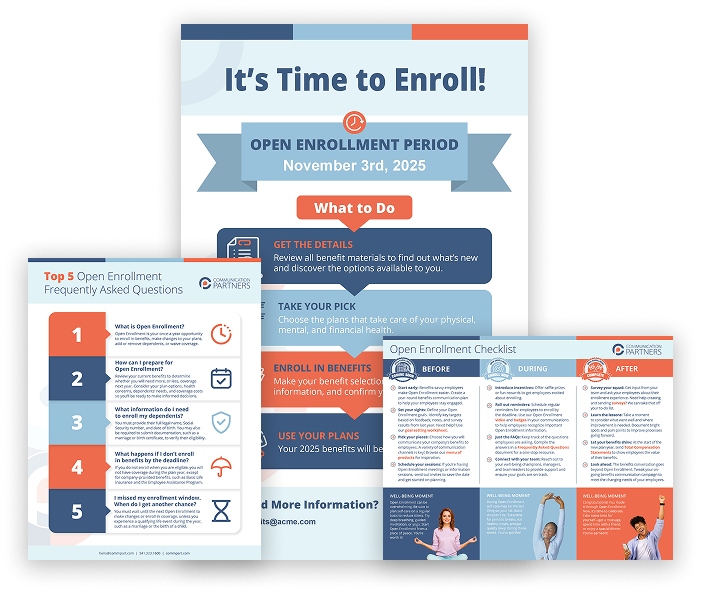
Click the button below to view and download your FREE Enrollment Toolkit.
Providing the highest level of hospitality is important to us. Surveys give us the feedback we need to continually meet this goal. We’re pretty proud of our Net Promoter Score (NPS). Here’s why:
NPS is based on the percentage of survey respondents who are promoters, passives, and detractors:
Scores range from -100 to 100. The higher the score, the higher the percentage of promoters versus detractors.
| Above 0: Good |
| Above 20: Favorable |
| Above 50: Excellent |
| Above 80: World Class |
*Bain & Company, creators of NPS