
Most Open Enrollment campaigns start with the right intentions: explain the plans clearly, answer questions upfront, and give employees all the information they might need. But even with all that effort, a lot of the message gets missed.
That’s because employees aren’t reading benefits communications in a focused, distraction-free environment. They’re checking them between meetings, while making dinner, or late at night on their phones trying to remember:
The challenge is helping them quickly understand what matters to them, what changed, and what they need to do next.
Here are three ways to make Benefits communication easier to navigate and process:
By the time employees sit down to review their benefits, they’ve already spent the day making decisions about schedules, finances, appointments, and family responsibilities. Benefits enrollment becomes one more complex choice they have to make.
A little reassurance can go a long way. Language that feels clear, supportive, and practical helps employees feel less overwhelmed and more confident about what to do next.
You don’t need overly emotional messaging. Just enough empathy to acknowledge that employees are making important decisions while balancing everything else going on in their lives.
One reason employees tune out benefits communications is because they don’t immediately see how the information connects to their own lives. Listing plan features alone usually isn’t enough.
Instead, show how benefits support real situations employees may actually experience. For example:
Examples like these make benefits feel more practical, relevant, and easier to use.
Most employees aren’t sitting down to read a 24-page benefits guide cover to cover. They’re skimming for deadlines, looking for what changed, and trying to figure out what they need to do next.
That means communications should be designed to help employees find information quickly. A few ways to make that easier:
The easier the information is to scan, the more likely employees are to engage with it.
Make It Easy for Employees to Take Action
Employees don’t need to become benefits experts during Open Enrollment. They just need enough clarity and confidence to make informed decisions.
The most effective enrollment campaigns don’t try to say everything all at once. They simplify complex topics, answer common questions before employees have to ask them, and make next steps easy to find.
For engaging benefits communication that employees can quickly understand and act on, reach out to your CPI project manager or contact us at hello@commpart.com.
Contact our award-winning experts.
View our product videos.
Download the possibilities.
By submitting your email address, you agree to receive periodic communications from Communication Partners, Inc. We will never share your information with third parties or social marketing firms.
We use cookies to improve your experience on our site. By using our site, you consent to cookies.
Manage your cookie preferences below:
Essential cookies enable basic functions and are necessary for the proper function of the website.
You can find more information in our Privacy Policy and .
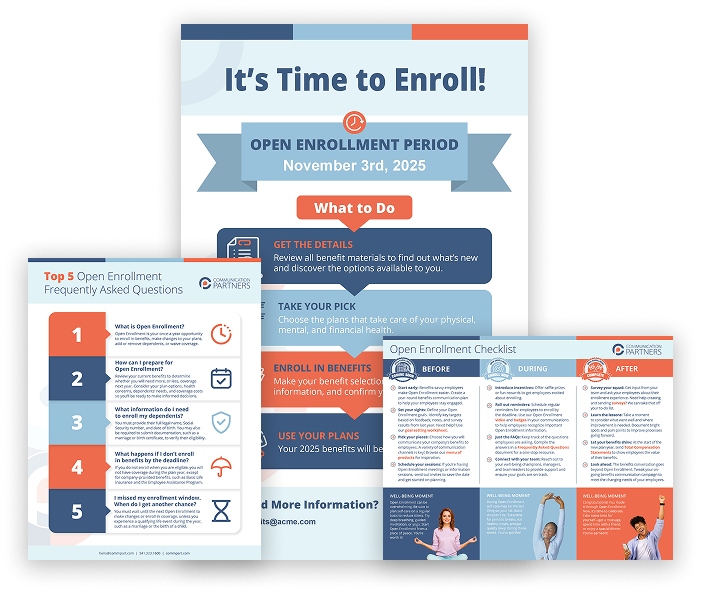
Click the button below to view and download your FREE Enrollment Toolkit.
Providing the highest level of hospitality is important to us. Surveys give us the feedback we need to continually meet this goal. We’re pretty proud of our Net Promoter Score (NPS). Here’s why:
NPS is based on the percentage of survey respondents who are promoters, passives, and detractors:
Scores range from -100 to 100. The higher the score, the higher the percentage of promoters versus detractors.
| Above 0: Good |
| Above 20: Favorable |
| Above 50: Excellent |
| Above 80: World Class |
*Bain & Company, creators of NPS