
With AI, one prompt can generate dozens of ideas, paragraphs, or even entire articles in seconds. The output, however, can range from content that misses the mark completely to content that’s close but needs refinement, fact-checking, or additional context before it’s ready for employees.
Knowing the difference takes experience. In benefits communication, where employees are making healthcare and financial decisions based on the information they’re given, accuracy and clarity matter.
Efficiency is helpful, especially when managing complex benefits programs, unique audiences, and tight timelines. But faster does not necessarily mean better when it comes to communication. Without the thoughtful review and direction, AI can create more information for employees to sort through without providing value. What employees need is clarity.
Strong benefits communication helps employees understand their options. It explains trade-offs, addresses common questions, and focuses attention on the information that matters most.
Take a medical plan comparison. AI can summarize the deductible, out-of-pocket limits, and coverage tiers instantly. That may be useful as a starting point, but employees are usually trying to answer more personal questions.
Which plan may cost less if I see specialists often? How will my prescriptions be covered? Does an HSA make sense for my family? What am I giving up if I choose the plan with the lower premium?
Helping employees weigh those trade-offs requires understanding how they make decisions and which information will benefit them most.
As author Stephen King famously said, “To write is human, to edit is divine.” One of the most challenging parts of benefits communication is editing. When there’s too much information, everything can seem equally important.
Skilled communicators know that not every detail deserves equal attention. They determine what belongs in the guide and what belongs on the benefits site. They know when a visual will work harder than a paragraph, when a real-life example will make a concept clearer, and when a section has become too dense or too full of jargon.
AI can quickly generate many versions of a paragraph in seconds, but choosing the one that works best, or recognizing that none of them are right yet, still requires human judgment.
Ignoring AI is not realistic, and blindly relying on it is not smart. The best results come from using AI as a tool within a thoughtful communication process.
AI can help us create faster, explore ideas, and build more efficient workflows. Human expertise makes sure the communication is accurate, relevant, and meaningful to employees every step of the way.
At CPI, our team includes skilled benefits communication professionals across project management, design, and content strategy. For experienced, human-led guidance on benefits communications, contact us at hello@commpart.com.
Contact our award-winning experts.
View our product videos.
Download the possibilities.
By submitting your email address, you agree to receive periodic communications from Communication Partners, Inc. We will never share your information with third parties or social marketing firms.
We use cookies to improve your experience on our site. By using our site, you consent to cookies.
Manage your cookie preferences below:
Essential cookies enable basic functions and are necessary for the proper function of the website.
You can find more information in our Privacy Policy and .
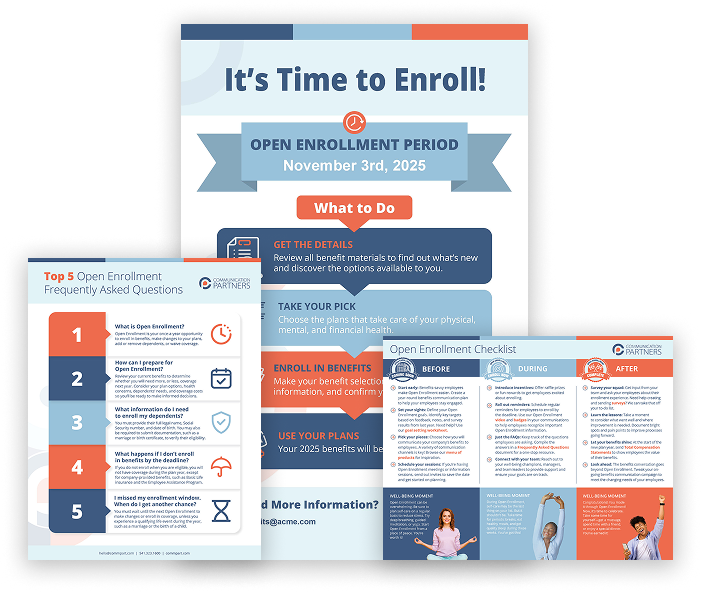
Click the button below to view and download your FREE Enrollment Toolkit.
Providing the highest level of hospitality is important to us. Surveys give us the feedback we need to continually meet this goal. We’re pretty proud of our Net Promoter Score (NPS). Here’s why:
NPS is based on the percentage of survey respondents who are promoters, passives, and detractors:
Scores range from -100 to 100. The higher the score, the higher the percentage of promoters versus detractors.
| Above 0: Good |
| Above 20: Favorable |
| Above 50: Excellent |
| Above 80: World Class |
*Bain & Company, creators of NPS