
Which Messages Get Used & Which Get Ignored
You have about seven seconds.
That’s roughly how long someone gives a message before deciding whether it’s worth their attention. In those first few seconds, they aren’t analyzing strategy, appreciating clever copy, or admiring your brand voice.
They’re asking two simple questions:
Is this for me?
Do I need it right now?
If the answer isn’t immediately clear, the message is easy to ignore, delete, or mentally file away for “later.” When it comes to benefit communications, passing the 7-Second-Test is often the difference between engagement and invisibility.
The 7-Second-Test isn’t a formal framework. It’s a reality check. When employees see a message, whether via email, postcard, flyer, or portal alert, they subconsciously scan for meaning. They want to know:
If those answers aren’t obvious almost instantly, the message becomes noise. Even if the content is important. Even if the information is accurate.
We often assume employees will slow down and read carefully because, well, benefits matter. In reality, benefits communication is competing with work tasks, personal responsibilities, and a constant stream of other messages. Attention isn’t guaranteed. It must be earned.
Most benefit communications don’t fail because they’re wrong. They fail because they’re unclear.
The biggest breakdown we see is trying to explain everything, all at once. Messages often lead with long explanations before getting to the point, internal language that makes sense to HR but not employees, vague subject lines like “Important Benefits Update,” or dense blocks of text that require effort to decode.
By the time the value shows up, the moment has already passed. Employees don’t disengage because they don’t care. They disengage because they can’t quickly tell why a message matters to them.
Passing the 7-Second-Test doesn’t require the world’s most clever copy or some creative new trick. It comes down to a few fundamentals, done well.
Messages that work lead with clarity. Employees should understand—almost immediately—why the message matters and what, if anything, they need to do. Not every detail belongs upfront. Attention comes first.
Messages that pass the 7-Second-Test:
The strongest communications also reflect how people actually read. Most employees scan, not study. That makes structure and visual hierarchy just as important as the words themselves. Clear headlines, short sections, and intentional design reduce effort and guide the eye.
Most employees scan, which makes visual structure just as important as words. Strong design helps guide the eye and reduce effort.
As we shared in last month’s blog, Why Timing Beats Targeting, even the clearest message can fall flat if it arrives at the wrong moment. When communication aligns with real-life events or milestones, relevance is immediately understood. The message doesn’t have to work as hard, because the context does some of the work for you.
Before sending your next benefits message, pause and ask one question:
Would someone understand why this matters to them within seven seconds?
If the answer is yes, you’re on the right track. If the answer is no, the message likely needs more clarity, not more content.
Making this work consistently takes more than good intentions. It takes a clear strategy, the right tools, and experience. Through clear content, thoughtful design, and event-driven delivery, CPI helps organizations deliver communications that don’t just get sent; they get noticed, understood, and used.
If you’d like a second set of eyes on your communications, our team at CPI is happy to help. Fill out this form or email hello@commpart.com.
Contact our award-winning experts.
View our product videos.
Download the possibilities.
By submitting your email address, you agree to receive periodic communications from Communication Partners, Inc. We will never share your information with third parties or social marketing firms.
We use cookies to improve your experience on our site. By using our site, you consent to cookies.
Manage your cookie preferences below:
Essential cookies enable basic functions and are necessary for the proper function of the website.
You can find more information in our Privacy Policy and .
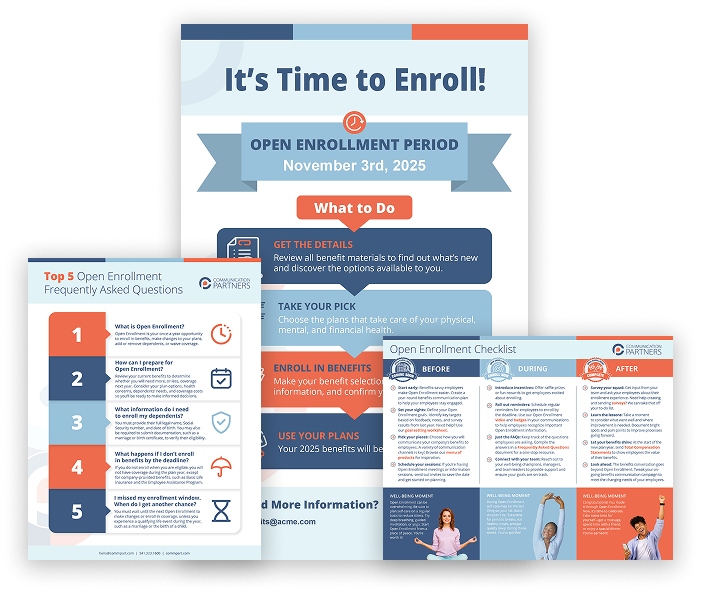
Click the button below to view and download your FREE Enrollment Toolkit.
Providing the highest level of hospitality is important to us. Surveys give us the feedback we need to continually meet this goal. We’re pretty proud of our Net Promoter Score (NPS). Here’s why:
NPS is based on the percentage of survey respondents who are promoters, passives, and detractors:
Scores range from -100 to 100. The higher the score, the higher the percentage of promoters versus detractors.
| Above 0: Good |
| Above 20: Favorable |
| Above 50: Excellent |
| Above 80: World Class |
*Bain & Company, creators of NPS