
When was the last time you remembered a list of facts, word-for-word? Let’s be honest: probably never. But a good story? That sticks.
As a student, I had little interest in the Revolutionary War until my teacher stopped lecturing about dates and battles and instead told the story of a young soldier who lied about his age to fight for the independence of his fledgling country. Suddenly, history wasn’t just facts in a textbook. It was real. It mattered.
Benefits communication works the same way. Employees may zone out reading a list of bullet points about deductibles and FSAs, but sharing a story highlights how benefits impact real people, facing everyday challenges. A chart of plan options might get ignored, but a story about how Sarah’s Dependent Care FSA helped her pay for childcare is the kind of thing employees remember and act on.
Stories turn dry and abstract information into something relatable, making benefits easier to understand, more engaging, and ultimately, more useful and used—a win for everyone!
Numbers and definitions can explain a benefit, but they don’t necessarily make it feel relevant. Employees don’t just want to know what a benefit does—they need to understand why it matters. A compelling narrative can transform an overlooked benefit into something personal, practical, and worth paying attention to.
For example, telling employees that disability insurance offers income replacement is helpful, but it doesn’t tell the “why.” Imagine sharing Alex’s story instead:
“Alex never thought he’d need disability insurance. But after a car accident left him unable to work for three months, it covered 60% of his paycheck. He was able to pay his mortgage, buy groceries, and keep his life on track while he recovered.”
Suddenly, disability insurance isn’t just a line in a benefits guide. It’s financial security that makes sense.
Insurance is infamous for being difficult to understand, largely because many of the words we use to explain it simply aren’t part of our everyday language. This results in people not understanding the ideas, even if they are technically reading the words.
Take an HSA, for example. We could explain it like this: “An HSA offers you a triple tax advantage, allowing you to save pre-tax dollars to pay for eligible medical expenses.”
But the point is better made through a relatable story:
“When Jake’s child needed braces, he was relieved to have an HSA. He had been contributing money (pre-tax!) each paycheck and had been earning interest on the account (not taxed!) for the past three years. Then, instead of stressing when the bill arrived, he used his savings to help cover the cost, also tax-free! No scrambling, no huge credit card debt—just peace of mind knowing he had planned ahead.”
This version helps employees see how an HSA works in real life. Now, it’s not just a savings account; it’s a smart way to prepare for the unexpected.
People don’t make decisions based on facts alone. Emotions play significant role, even more than most would like to admit. If we want employees to see the value of life insurance, telling them the payout amount isn’t enough. Instead, it’s important to show them why it matters.
Rather than saying, “Life insurance provides financial protection for your loved ones,” we could say:
“When Marcus passed away after a battle with cancer, his family didn’t have the additional worry about how they’d pay the mortgage or college bills for his two children. His life insurance gave them financial security during an incredibly difficult time.”
This version makes it personal. Employees aren’t just reading about a benefit; they’re imagining how it could help their family.
Real employee voices make benefits feel personal and trustworthy. A testimonial like “I never thought I’d use my EAP, but when I was struggling with stress, talking to a counselor really helped,” is more powerful than a paragraph explaining the program.
The best benefits won’t help employees if they don’t use them. A compelling story makes a person think, “That could be me.” It gets them to enroll, start saving, and take advantage of the programs available to them.
Just like history became real when my teacher told an inspiring story of bravery, benefits become meaningful when employees see them in action. A list of facts and figures might not stay with them, but a relatable story will. When employees hear how a benefit helped someone like them, they connect with it, understand it, and are more likely to use it. If we want employees to engage with their benefits, we need to move beyond the jargon and tell the stories that bring them to life.
Contact our award-winning experts.
View our product videos.
Download the possibilities.
By submitting your email address, you agree to receive periodic communications from Communication Partners, Inc. We will never share your information with third parties or social marketing firms.
We use cookies to improve your experience on our site. By using our site, you consent to cookies.
Manage your cookie preferences below:
Essential cookies enable basic functions and are necessary for the proper function of the website.
You can find more information in our Privacy Policy and .
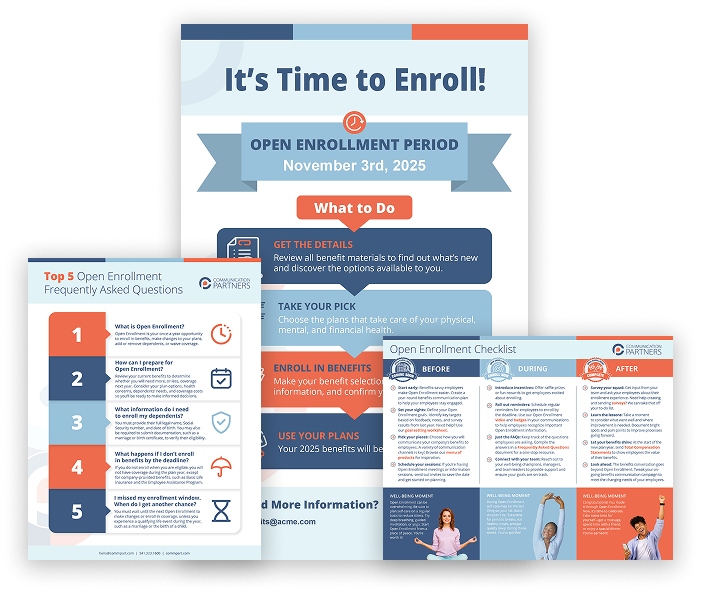
Click the button below to view and download your FREE Enrollment Toolkit.
Providing the highest level of hospitality is important to us. Surveys give us the feedback we need to continually meet this goal. We’re pretty proud of our Net Promoter Score (NPS). Here’s why:
NPS is based on the percentage of survey respondents who are promoters, passives, and detractors:
Scores range from -100 to 100. The higher the score, the higher the percentage of promoters versus detractors.
| Above 0: Good |
| Above 20: Favorable |
| Above 50: Excellent |
| Above 80: World Class |
*Bain & Company, creators of NPS